Introduction
Digital marketing has become one of the most important ways for businesses to attract customers, build trust and increase sales. Whether you run a local business, an online store, a personal brand or a growing company, your customers are already searching, comparing and making decisions online.For additional SEO guidance, Google Search Central provides useful resources for website owners.
A successful digital marketing strategy is not simply about posting on social media or running advertisements. It is about understanding your audience, creating useful content, appearing in search results, building credibility and measuring what actually produces results.
What Is Digital Marketing?
Digital marketing is the promotion of products, services or brands through digital channels such as search engines, websites, social media, email, online advertising and content platforms. Unlike traditional marketing, digital campaigns can be measured in detail, allowing businesses to understand where visitors come from and how they interact with a website.
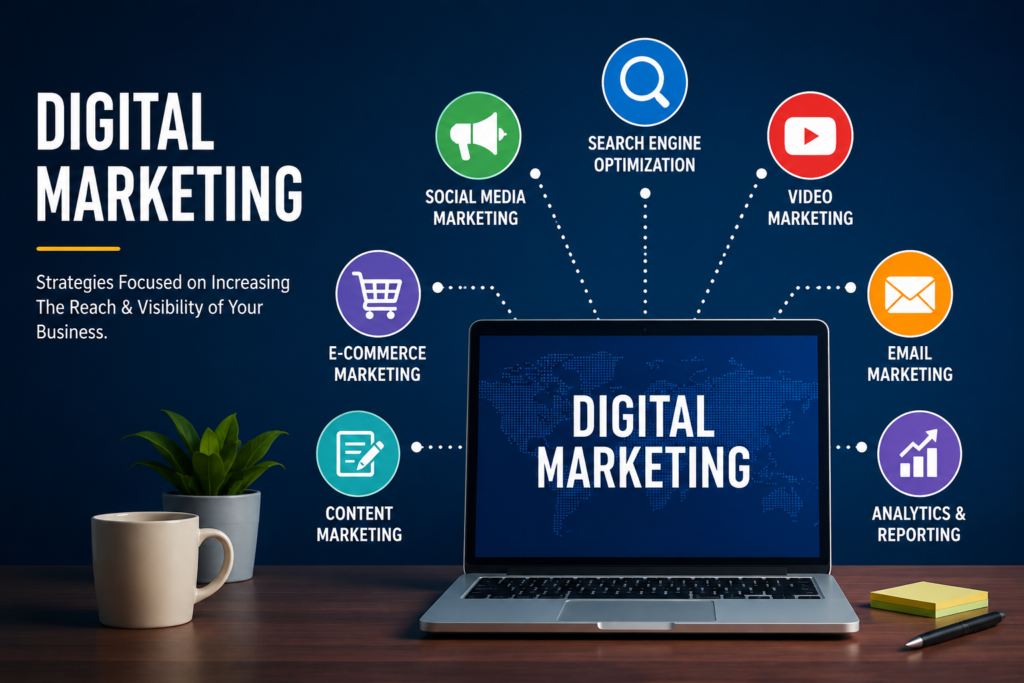
The strongest strategies combine several channels instead of depending on only one. SEO can bring long-term organic traffic, social media can build awareness and community, content can establish expertise, and paid advertising can provide faster visibility.
1. Digital Marketing and Search Engine Optimization (SEO)
SEO helps a website become more visible when people search for relevant products, services or information. Good SEO starts with understanding search intent and choosing keywords that match what your ideal customers are actually looking for.
Important areas include useful and original content, clear page structure, descriptive titles and headings, internal linking, fast performance, mobile usability and authoritative backlinks. Local businesses should also optimize their online presence for location-based searches.
The goal should not be to fill a page with keywords. The goal is to create the best possible answer for the person behind the search.
2. Content Marketing
Content marketing attracts potential customers by giving them useful information before asking them to buy. Blog articles, guides, case studies, videos, infographics and social posts can all support the customer journey.
For example, a web development company could publish an article about website costs, a guide to improving website speed and a case study showing how a redesigned website improved conversions. This type of content can attract people at different stages of the buying process.
3. Social Media Marketing
Social media gives brands an opportunity to communicate directly with their audience. The most effective accounts usually have a clear purpose rather than posting randomly.
A practical content mix can include educational posts, behind-the-scenes content, client results, short videos, industry insights and direct offers. Consistency matters, but quality and relevance matter more than simply posting every day.
4. Performance Marketing and Paid Ads
Paid advertising can help a business reach a targeted audience quickly. Search ads can capture people who are already looking for a solution, while social advertising can introduce products or services to specific audience segments.
Successful paid campaigns depend on more than an attractive advertisement. The landing page, offer, message, targeting and follow-up process all influence the final result. Businesses should track metrics such as cost per lead, conversion rate and return on ad spend instead of focusing only on clicks.
5. Website and Conversion Optimization
Your website is often the place where marketing turns attention into action. A beautiful website is useful, but it should also make it easy for visitors to understand what you offer and what they should do next.
Clear headlines, strong calls to action, simple navigation, mobile-friendly design, trust signals, testimonials and fast loading times can improve the user experience. Every marketing campaign should lead visitors to a relevant page instead of sending everyone to the same generic homepage.
6. Measure, Test and Improve
Digital marketing becomes much more powerful when decisions are based on data. Track where traffic comes from, which pages attract visitors, which campaigns generate leads and where potential customers leave the buying journey.
Testing different headlines, images, offers, landing pages and calls to action can reveal what your audience responds to. Marketing is an ongoing process: analyze the results, improve the weak areas and scale what works.
A Simple Digital Marketing Strategy
Define your ideal customer and the problem you solve.
Research relevant keywords and customer questions.
Build or improve a fast, mobile-friendly website.
Publish useful content that answers real customer needs.
Optimize important pages for SEO and local search where relevant.
Use social media to distribute content and build trust.
Run paid campaigns when you need targeted or faster reach.
Measure leads, conversions and revenue—not just likes and views.
Review performance regularly and improve your strategy.
Conclusion
Digital marketing works best when every channel supports the same business goal. SEO can create long-term visibility, content can build authority, social media can strengthen relationships, paid advertising can accelerate reach, and a well-designed website can turn visitors into customers.Want to improve your online presence? Explore my digital marketing services.
The businesses that succeed online are not necessarily the ones that spend the most. They are the ones that understand their audience, provide genuine value, measure their results and keep improving.
About the Author
Hilal Ayy oob is a digital marketing professional focused on digital marketing, SEO, website development and digital solutions. Through practical strategies and creative execution, the goal is to help businesses build a stronger online presence and generate meaningful growth.
Suggested SEO focus keyword: Digital Marketing
Suggested meta description: Learn how digital marketing, SEO, content, social media and paid advertising can help businesses grow their online presence and attract more customers.
7. Benefits of Digital Marketing for Businesses
Digital marketing gives businesses the opportunity to reach potential customers at the exact time they are searching for products, services or information. Instead of relying only on traditional advertising, businesses can use search engines, social media, websites, email and online advertising to connect with specific audiences.
One of the biggest advantages is measurable performance. Businesses can monitor website traffic, leads, conversions and customer behavior to understand which marketing activities are producing results. This makes it easier to improve campaigns and avoid spending money on strategies that are not delivering value.
Digital marketing can also help smaller businesses compete with larger companies. With a well-optimized website, useful content and a clear strategy, a local business can attract customers beyond its immediate location and build a strong online presence over time.
8. Local Digital Marketing
Local digital marketing is especially important for businesses that serve customers in a specific city, town or region. People often search for services using phrases such as “digital marketing agency near me,” “web developer in Kerala” or “SEO services in Malappuram.”
Businesses can improve their local visibility by creating location-focused website content, optimizing their Google Business Profile, collecting genuine customer reviews and maintaining consistent business information across relevant online platforms.
Local SEO should focus on providing useful information to customers rather than simply adding location names repeatedly. A business that clearly explains its services, service areas, experience and customer benefits has a better opportunity to attract relevant local visitors.
9. How to Choose the Right Digital Marketing Strategy
There is no single digital marketing strategy that works for every business. The right approach depends on the target audience, industry, budget, competition and business objectives.
A new business may initially focus on building a professional website, creating useful content and establishing a presence on relevant social media platforms. A business that already receives organic traffic may invest more heavily in SEO and conversion optimization, while a company launching a new product may use paid advertising to generate faster awareness.
The most effective strategy starts with a clear goal. Whether the objective is increasing website traffic, generating leads, getting more enquiries or increasing online sales, every marketing activity should support that goal.
10. Common Digital Marketing Mistakes to Avoid
Many businesses make the mistake of trying to use every digital marketing channel at the same time. This can spread resources too thin and make it difficult to determine what is actually working.
Another common mistake is focusing only on followers, likes and website traffic without measuring meaningful business results. High traffic is useful, but it does not automatically mean a business is generating more customers or revenue.
Businesses should also avoid copying competitors’ content, using excessive keywords or publishing low-quality articles simply to increase the number of pages on a website. A better approach is to create original, helpful content that answers real customer questions and supports the buying journey.
Finally, digital marketing should not be treated as a one-time activity. Search algorithms, customer behavior, competitors and online platforms continue to change. Regular analysis and improvement are essential for long-term results.